Back Pain and Strength Training: What the Evidence Actually Says
The single biggest myth in adult fitness is that strength training causes back pain. The published evidence (NICE NG59, Cochrane reviews, Foster et al. 2018 in The Lancet) points clearly in the opposite direction. Here is what the research actually says, and how to apply it safely.
In this article
The direct answer
For non-specific lower-back pain (the dull ache or stiffness that arrives without trauma and persists for weeks), the published clinical evidence consistently points to structured strength training as one of the most effective interventions, not the cause of the problem. NICE guideline NG59, multiple Cochrane reviews, and Foster et al. 2018 in The Lancet all reach the same conclusion: active loading beats rest, painkillers, and passive treatments. The myth that lifting “is bad for your back” is one of the costliest pieces of bad health advice in circulation. Red-flag symptoms (leg radiation, numbness, night pain, recent trauma) need clinical assessment first; without them, active training is the right move.
What the evidence actually says
The three sources with the strongest claim to current clinical authority on adult lower-back pain in the UK:
NICE NG59: Low back pain and sciatica in over 16s. First published 2016, updated 2020, freely available at nice.org.uk/guidance/ng59. The headline recommendations:
- First-line treatment: a structured exercise programme: explicitly biomechanical, aerobic, mind-body, or a combination.
- Not recommended as first-line: rest, opioid prescription, passive treatments alone (acupuncture without exercise, TENS, ultrasound, traction).
- Surgical referral is reserved for cases with neurological symptoms or failure to respond to conservative treatment.
Cochrane reviews on exercise for chronic lower-back pain. Multiple meta-analyses (notably Hayden 2021) consistently find that supervised resistance training produces moderate-to-strong improvements in pain and function compared to no-exercise control. The effect is dose-dependent: 12 weeks beats 4 weeks; 3 sessions a week beats 1.
Foster et al. 2018, The Lancet “Prevention and treatment of low back pain” series. A landmark three-paper review that concluded the global standard of care for adult lower-back pain (rest, painkillers, imaging) is largely inverted from what the evidence supports. The Lancet papers are freely available and the headline conclusion (that adult back pain is overmedicalised and undertrained) has been widely cited.
The mechanism behind why strength training helps is not mysterious. Most adult back pain is downstream of inactive glutes, weak hamstrings, and tight hip flexors: the desk-job pattern (see also our guide on strength training around a desk job). The spine compensates for the weak posterior chain by handling load it was never designed to handle alone. Strengthening the posterior chain shifts the load back to the muscles designed for it. The pain reduces because the body stops asking the spine to do the hamstrings’ job.
What kinds of training help
The published evidence is strongest for:
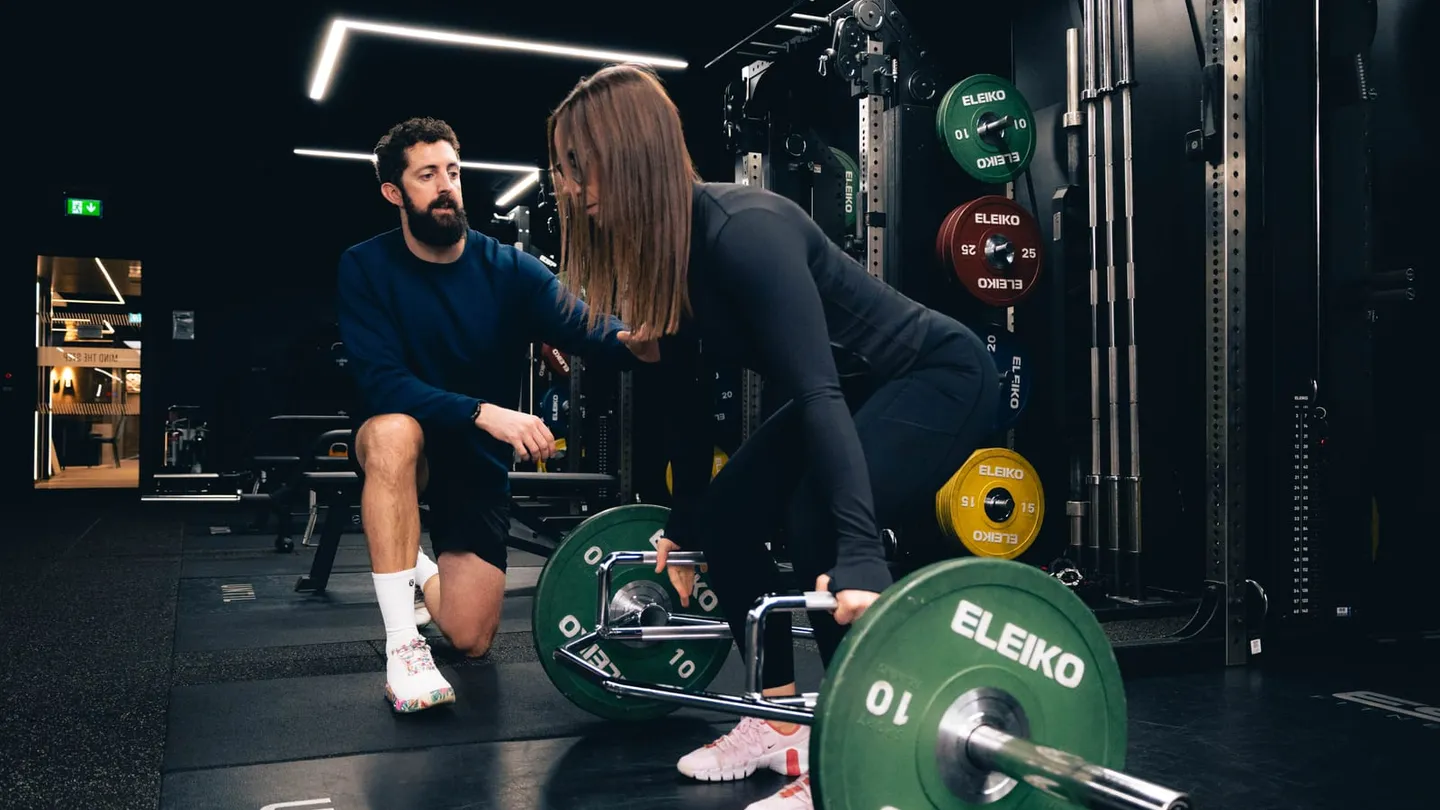
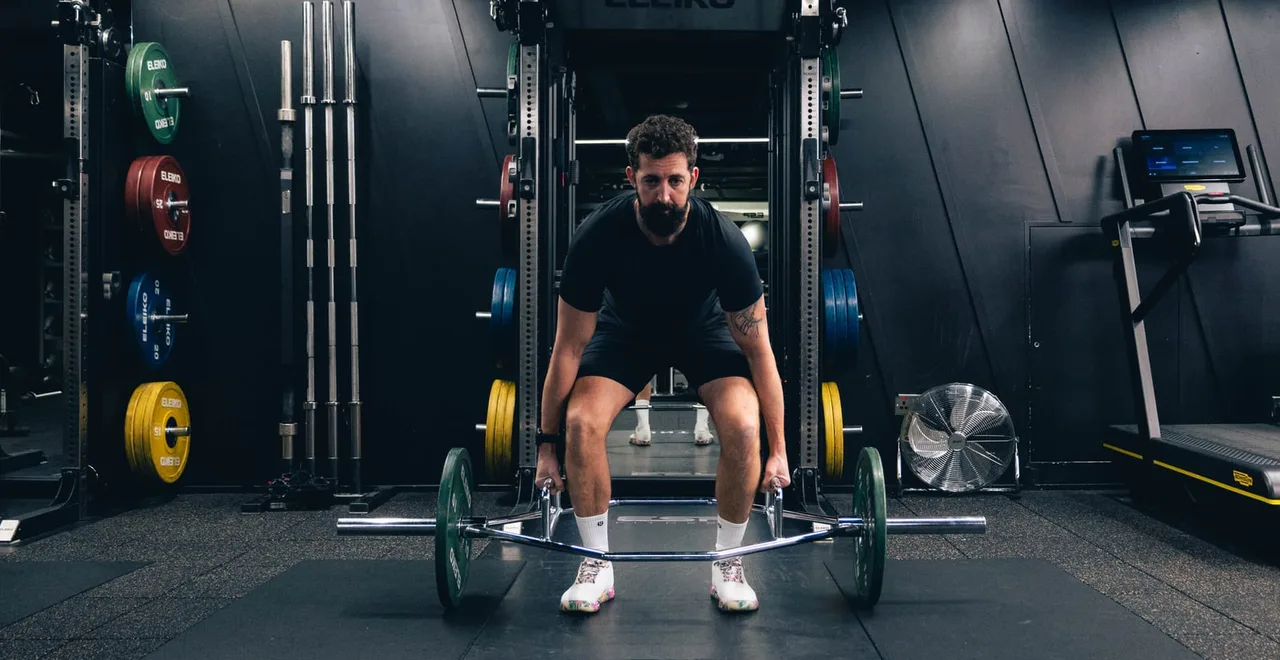
- Hip-dominant compound lifts: deadlift variants (Romanian deadlift, single-leg RDL, kettlebell swing, sumo deadlift) load the posterior chain directly. The Welch et al. 2015 trial on progressive deadlift training in chronic back pain patients produced one of the strongest individual effect sizes in the literature.
- Hip thrusts and glute bridges: direct gluteal loading. Particularly effective in adults whose glutes have been inactive for years.
- Anti-rotation core work: Pallof press, dead bugs, bird dogs. Builds the spinal stability that supports compound lifting.
- Loaded carries: farmer carries, suitcase carries. Trains the core under structural load without compressing the spine.
The evidence is weaker or absent for:
- Pure spinal-extension training (Roman chair, back extensions). Often the first exercise prescribed; not particularly evidence-supported beyond modest effects.
- Crunches and sit-ups. Beyond limited acute use, crunches are not particularly effective and can aggravate spines that are already irritated.
- Stretching alone, without loading. Stretching helps short-term mobility; it does not produce the resilience that prevents future pain.
The right programme is mostly compound loading + targeted mobility + a small amount of core work, not extensive corrective exercise prescribed in isolation.
What gets in the way of treatment
The pattern in 12 years of coaching adult clients with back pain history:
1. The fear of loading. Clients who have been told “be careful with your back” for years arrive convinced that any load will make it worse. The evidence is the opposite: appropriate loading is what builds the resilience that prevents future pain. The first 4 weeks of training are designed to demonstrate this to the client: their back is more robust than they have been told.
2. The over-reliance on passive treatments. Massage, physiotherapy adjustments, and acupuncture can be useful short-term, but the published evidence is clear that they do not produce durable change without active loading. Many clients use them to delay the active treatment that would actually help.
3. Imaging that produces fear, not information. MRI findings in asymptomatic adults over 40 routinely show “degenerative disc disease”, “disc bulges”, and “annular tears”. These findings are statistically more common in pain-free adults than in patients with active back pain. Imaging is appropriate when there are red-flag symptoms; it is unhelpful in routine non-specific cases. Foster et al. 2018 calls overuse of imaging out specifically as a cause of unnecessary fear, surgery, and inactivity.
4. The assumption that pain = damage. Acute pain often correlates with tissue damage; chronic pain after the acute phase often does not. The pain system can become sensitised: pain persists even after tissue healing is complete. Strength training helps in part because it produces the predictable, controllable input that re-trains the pain system that something safe is happening.
When to see a clinician first
Red-flag symptoms requiring clinical assessment before any structured training:
- Pain that radiates down the leg below the knee (suggests nerve root involvement)
- Numbness or weakness in the leg or foot
- Loss of bowel or bladder control: this is a medical emergency (cauda equina syndrome); A&E rather than GP
- Night pain unrelieved by position changes
- Fever or unexplained weight change alongside the pain
- Pain following recent significant trauma (fall, accident, contact injury)
- History of cancer, particularly known spinal metastatic risk
The honest pattern: most adult back pain is non-specific. Red flags are uncommon. But when they are present, training first is the wrong move. See a GP or A&E first, get cleared, then start the structured loading.
How a Longevity Assessment handles back pain
At intake, every Longevity Assessment includes:
- A structured back pain history: onset, duration, prior episodes, prior treatments, red-flag screen
- Movement screening with attention to the patterns most associated with back pain (hip flexion, hip extension range, thoracic extension, spinal flexion under load)
- Strength baseline: at deliberately conservative loads to identify movement quality before progressing
- A recommended training plan that respects the client’s current capacity and history
If red flags appear during the screen, the assessment ends with a referral recommendation (physiotherapy, GP, or A&E depending on severity) rather than a training programme. The coach’s job at that point is to route the patient to clinical care, not to attempt to treat a condition outside the scope of strength coaching.
Bottom line
The clinical evidence on adult lower-back pain is more settled than the public conversation suggests. Structured strength training is the first-line treatment for non-specific cases, per NICE, Cochrane, and The Lancet. Loading is not the cause of the pain; it is the solution. The work is to address the underlying pattern (usually the desk-job posterior-chain weakness), build resilience through structured progression, and stay consistent across months rather than chasing shortcuts.
If the pain has red flags, see a clinician first. If it doesn’t, the question is not whether to train: it is who you train with, and whether they understand how to programme for an adult body that has spent twenty years in a chair.
Frequently asked questions
Is strength training safe if I have lower-back pain?
For non-specific lower-back pain (the kind that arrives without trauma and lingers as a dull ache or stiffness), structured strength training is one of the most evidence-supported interventions in the published literature. NICE guideline NG59, multiple Cochrane reviews, and Foster et al. 2018 in The Lancet all conclude that active exercise, particularly resistance training and structured movement, produces better outcomes than rest, painkillers, or passive treatments. Red-flag symptoms (radiating leg pain, numbness, weakness, night pain, fever) need clinical assessment before training.
What kind of strength training helps back pain?
The published evidence supports structured, progressive resistance training of the hip-dominant patterns (deadlifts, hip thrusts, RDLs) and the core (planks, dead bugs, anti-rotation work) more strongly than spinal-extension-focused exercises. The mechanism is restored posterior-chain function rather than spinal manipulation. Most adult back pain is downstream of inactive glutes and weak hamstrings rather than a structural spine problem. Strengthening the posterior chain shifts the load away from the lumbar spine and back onto the muscles designed to handle it.
Should I avoid deadlifts if my back hurts?
Counterintuitively, no, provided the load is appropriate and the technique is structured. Multiple trials (notably Welch et al. 2015) found progressive deadlift training reduced chronic lower-back pain in adults compared to standard care. The key is starting at a load that is comfortably achievable, building movement competence first, then progressing the load on the data. Loading without movement quality is what causes injuries; loading appropriately is what builds the resilience that prevents future pain.
When should I see a clinician before training?
Red-flag symptoms require clinical assessment before any structured training: pain that radiates down the leg below the knee (suggests nerve root involvement), numbness or weakness in the leg or foot, loss of bowel or bladder control (a medical emergency), night pain unrelieved by position changes, fever or unexplained weight change alongside the pain, or pain following recent significant trauma. Without red flags, non-specific lower-back pain is best treated actively rather than rested.
What does the NICE guideline actually say?
NICE NG59 (low back pain and sciatica in over 16s, 2016, updated 2020) explicitly recommends a structured exercise programme as the first-line treatment for non-specific lower-back pain. It specifically lists biomechanical, aerobic, mind-body, or a combination as appropriate options. It explicitly does NOT recommend rest, opioid prescription as first-line treatment, or passive treatments alone (acupuncture without exercise, TENS, traction, ultrasound). The guideline is freely available at nice.org.uk/guidance/ng59.
How long until I notice a difference?
Most clients with non-specific lower-back pain report subjective improvement within 4 to 8 weeks of structured training (sleep quality + pain intensity tend to improve first, even before the lifts progress visibly). Visible strength gains and functional capacity changes typically arrive at 8 to 12 weeks. Sustained relief that holds without active training is uncommon. The published evidence supports ongoing structured movement as part of long-term management, not a 12-week course followed by a return to inactivity.
Is it different if my back pain is post-surgical?
Yes. Post-surgical training (post-discectomy, post-laminectomy, post-fusion) requires clearance from the operating surgeon and ideally co-management with a physiotherapist for the first 8 to 12 weeks. Structured strength training is generally introduced after the surgical wound has healed and the physiotherapy mobility work is established. The principles are the same (hip-dominant, gradual progression, technique-first) but the timeline is slower and the supervision is closer.