Strength Training Around a Desk Job: A Programme That Fits the Schedule
Eleven hours at a desk does specific things to the body. Generic gym programmes ignore them. Here is what changes, and the structured programming that addresses it without adding hours to the week.
In this article
The direct answer
For a senior professional working 50 to 60 hours a week at a desk, the realistic structured strength training programme is two to three sessions per week of 50 to 75 minutes, organised around three specific priorities that desk work creates: hip flexor mobility, thoracic extension, and posterior-chain strength. Adding generic gym work on top of a desk job ignores the underlying movement pattern and produces slow, frustrating results. Designing the programme to address the desk-job pattern is what unlocks the difference.
What a desk job actually does to the body
Eleven hours of seated work (typical for a partner-level City professional during deal-flow season) produces a specific and repeatable set of effects:
- Hip flexors shorten. The iliopsoas (the major hip flexor connecting the lumbar spine to the femur) tightens with prolonged sitting. The downstream effect: the pelvis tilts forward, the lower back compresses, and the glutes effectively switch off (some evidence links prolonged sitting to reduced gluteal activation that doesn’t fully return without active work).
- Thoracic spine loses extension range. Hours of laptop-and-monitor work pull the upper back into a rounded position. The thoracic vertebrae lose extension range; the shoulders pull forward; the cervical spine compensates by tilting the head forward.
- Hamstrings tighten in a shortened position. Sitting holds the hamstrings at a moderate length but with zero loading. Over months and years this produces hamstrings that test “tight” on a forward-fold but are not actually long enough to safely deadlift heavy.
- Posterior chain weakens. The combination of inactive glutes, shortened hip flexors, and untrained hamstrings produces a body where the front of the legs is overactive and the back of the legs is underactive. This pattern is the single biggest cause of non-specific lower-back pain in adults aged 35 to 60.
None of this is permanent. All of it is fixable. But generic gym programmes (the kind a typical PT delivers) do not address it. They add load on top of the dysfunction. The body adapts to the load by recruiting whatever is available, which means recruiting the front of the body even more. Six months in, the back pain is worse, the strength gains are slow, and the client concludes that training isn’t working.
The fix is not more time at the gym. The fix is programming that addresses the desk-job pattern directly: fewer minutes, better selected, sequenced correctly.
The three priorities
Priority 1: Hip flexor mobility + glute activation
The first 10 minutes of every session should include:
- 90/90 hip stretch (3 minutes per side): addresses the iliopsoas shortening
- Banded glute activation (2 sets of 12 banded glute bridges or banded clamshells): wakes up the glutes before any lifting
- Couch stretch (1 minute per side): addresses the rectus femoris (part of the quadriceps that crosses the hip)
This is non-negotiable. Skipping this work and going straight into compound lifts is the single biggest cause of poor returns from training in the desk-working population.
Priority 2: Thoracic extension + scapular control
Two to three times a week, integrate:
- Foam roller thoracic extension (2 minutes): addresses the rounded-upper-back pattern
- Wall slides (2 sets of 10): scapular control under range
- Band pull-aparts (2 sets of 15): posterior shoulder and mid-back strength
- Face pulls (2 sets of 12) once available: the single best exercise for reversing desk-rounded shoulders
Combined with the hip mobility work, these 5 minutes of corrective work produce visible posture changes within 4 to 6 weeks.
Priority 3: Posterior chain loading
After the corrective work, the actual strength training is posterior-chain dominant:
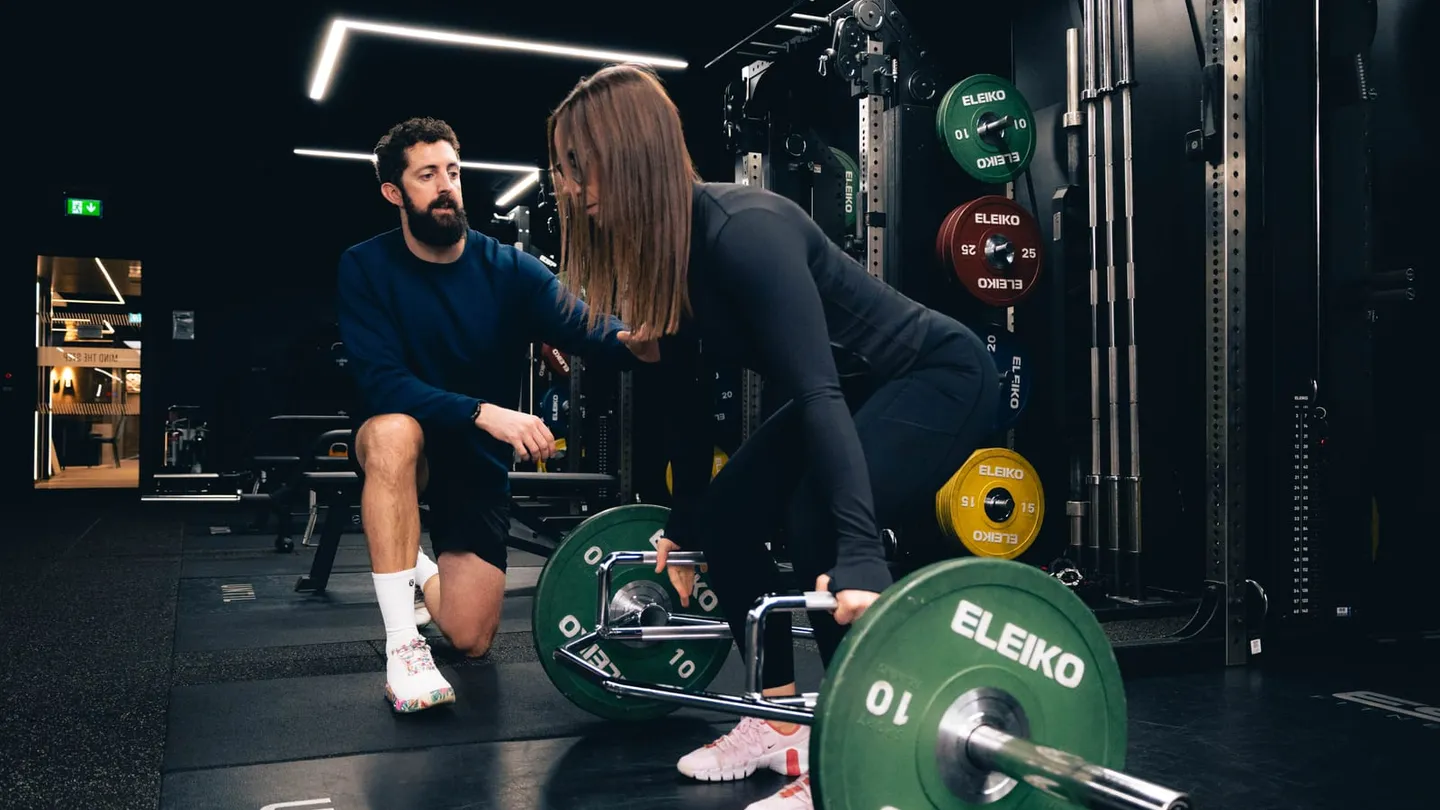
- Deadlift (or RDL / single-leg RDL for beginners): the strongest exercise for restoring posterior-chain function
- Hip thrust: direct gluteal loading; uniquely effective for adults whose glutes have spent years inactive
- Pull-ups / pulldowns: upper-back strength to balance the upper-body posture
- Farmer carries: grip + core + posture under load
The volume and load on these is moderated based on the client’s recovery capacity, not their motivation. Most desk-based professionals have very high motivation and very limited recovery: programming has to manage the gap.
A realistic weekly template
The “fits-the-schedule” version of a structured programme for a 50-hour-week professional:
| Day | Session | Time |
|---|---|---|
| Monday | Strength A: Lower body + posterior chain | 60–75 min |
| Tuesday | Optional: 30-min Zone 2 walk / cycle (recovery) | 30 min |
| Wednesday | (rest) | : |
| Thursday | Strength B: Upper body + horizontal/vertical pull | 60–75 min |
| Friday | (rest) | : |
| Saturday | Strength C OR longer Zone 2 work | 60–90 min |
| Sunday | (rest) | : |
That is 2 strength sessions plus 1 optional + 1 light recovery session: roughly 4 hours of training across the week. Hitting two sessions consistently is the floor. Hitting three is a stretch goal that produces faster gains but is not required.
Why intensity is the wrong target
The instinct of high-performing professionals is to apply maximum intensity to training, the same way they apply maximum intensity to work. This is the wrong default for desk-based bodies.
Higher intensity in the gym requires higher recovery capacity. A 50-year-old partner with two children, a 60-hour week, and average sleep does not have the same recovery capacity as a 25-year-old athlete. Treating the training session the way you treat a deal close (full intensity, push past the limits) produces predictable results: a strain in the lower back at week 6, a tweaked shoulder at week 10, the programme abandoned by month 4.
The right default is structured progression at sub-maximal intensity. Lifts climb week-on-week in a managed pattern, not session-to-session in a chaotic one. Recovery is treated as part of the training, not an interruption to it. The result is sustainable strength that compounds across years.
What changes in 12 weeks
For a typical 50-year-old senior professional starting from a moderately active but inconsistently-trained baseline:
- Lift progression of 15 to 30% on the main compound movements
- Visible posture change: particularly in the upper back and shoulder carriage
- Reduced lower-back pain in the majority of clients who arrived with it
- Improved sleep quality (subjective but consistent: typically reported by week 6 to 8)
- Modestly improved cardiovascular markers (resting heart rate, blood pressure) when Zone 2 work is added
What does not typically change in 12 weeks: a dramatic shift in body weight or composition. The body recomposes before it drops weight. That trajectory is positive but slow: measurable changes at 6 to 12 months, not 12 weeks.
What gets in the way
The honest pattern from 12 years of coaching senior professionals: programme adherence fails for three reasons, in order of frequency.
- Travel weeks erode consistency. Two weeks out of four on the road, without a travel-resilient protocol, drops the week-on-week progression that compounds over years. Solution: a structured 4-day travel programme that maintains capacity with minimal equipment.
- Deal-flow season erodes recovery. Sleep drops to 5 hours, stress climbs, recovery markers crash. The training programme has to deload during these weeks, not push harder.
- The first 4 weeks are slow. The visible results are not yet there, the mobility work feels boring, the loads are conservative. Adherence is hardest in week 3. The clients who push through week 3 reach the inflection point at week 6 to 8 where the results start to compound.
Structured coaching addresses each of these (programming that adapts to travel, recovery, and life) rather than handing over a generic plan and hoping for the best.
Frequently asked questions
How many strength sessions per week is realistic with a desk-based 50+ hour week?
Two to three structured sessions per week is the realistic sustainable range for most senior professionals working 50 to 60 hours. More than three sessions typically erodes recovery for marginal benefit; fewer than two struggles to maintain progress. Sessions of 50 to 75 minutes are sufficient when programming is structured. The key is consistency over months, not intensity in any single week.
What does a desk job actually do to the body?
Eleven hours of seated work compresses the hip flexors, weakens the glutes (which lose activation with prolonged sitting), restricts thoracic extension (the upper-back rounding pattern), and shortens the hamstrings. None of this is permanent, but it does mean a structured strength programme needs to actively counter the pattern rather than just adding load on top of it.
Should I train before work or after work?
Both work; consistency matters more than timing. Early-morning sessions (06:00 to 08:00) suit clients with stable schedules and reliable sleep. Evening sessions (18:00 to 21:00) suit clients with unpredictable mornings. Lunchtime sessions are an option but the shower / re-dress logistics often erode the time benefit. The biggest predictor of success is matching the session time to the client's actual life, not to an optimal protocol.
Can I get strong if I can only commit to two sessions a week?
Yes, provided the programming reflects that. Two well-structured 60-minute sessions per week produces measurable strength progression for 12 to 24 months in clients who have never trained systematically. Three sessions adds maybe 25% more rate of progression but doubles the time commitment. For most senior professionals, two consistent sessions across two years beats three inconsistent sessions across six weeks.
What about my back pain?
Non-specific lower-back pain (the kind that arrives without trauma and lingers) responds well to structured hip-dominant and core training in the published evidence (NICE NG59, Cochrane reviews). Lifting is rarely the cause; sedentary work, poor sleep, and chronic stress more often are. If the pain has red flags (radiation down the leg, numbness, weakness, night pain), see a GP or physiotherapist before training. Once cleared, structured loading is part of the solution.
Do I need to fix my mobility before I start lifting?
No. Mobility work runs alongside loading, not before it. The right mobility cues are integrated into the warm-up of every session (10 minutes of targeted work such as hip flexor stretch, thoracic extension, ankle dorsiflexion) and the patterns of the lifts themselves. Insisting on "perfect mobility before any load" is a common reason adults stall on programme adherence. They never get to the part that produces visible results.
What if I travel two weeks a month?
Travel-resilient programming is a specific design problem. The principles are bodyweight + band-resistance work that produces measurable load with no equipment, a clear maintenance protocol that holds capacity during travel weeks, and structured re-loading when home. Online coaching is generally a better format than 1-to-1 for clients who travel heavily, because the programme adapts to the equipment available on any given week.